,
, 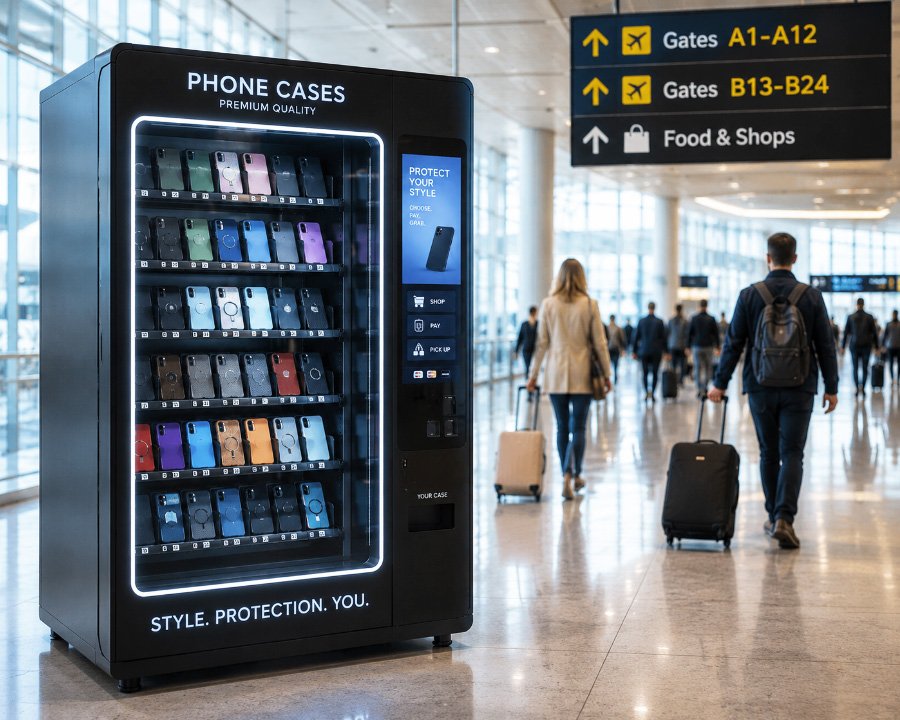
There is a familiar panic that hits when you realise your phone has no case on it. Maybe you just upgraded. Maybe the old case cracked. Maybe you are standing in an airport terminal about to board a four-hour flight and your phone is one bad drop away from a shattered screen. Whatever the situation, the usual solution has always been the same: find a phone accessories shop, hope they stock something that fits your model, and pay too much for a case that is either boring or badly made. That experience is changing fast, and a big part of the shift is the rise of the phone case vending machine, which lets you walk up, pick a design, and walk away with a custom case in minutes.
It sounds simple because it is. But the fact that this format is now appearing in shopping malls, airports, and high-footfall retail spaces across multiple countries says something interesting about where phone accessory shopping is heading.
Why the Timing Makes Sense
Phone cases used to be something you bought once, kept for a year or two, and replaced when your handset changed. That pattern has shifted. People change cases more often now, partly because cases have become more of a style accessory and partly because the variety available online has raised expectations. If you can get a fully custom-printed case delivered to your door, a rack of ten generic designs at an airport kiosk starts to feel like a very poor substitute.
Vending machine technology has caught up with that expectation in a way that the traditional retail format simply cannot. A machine takes up minimal floor space, does not require staff, runs around the clock, and can be stocked with a far wider range of designs than a staffed kiosk could ever display. For mall operators and airport concessions, the economics are attractive. For the customer, the convenience is the point.
What the Experience Actually Looks Like
If you have not used one of these machines, the process is more considered than you might expect from something that looks like it dispenses crisps.
You approach a screen, select your phone model from a list, browse available designs or upload your own, confirm the print, and the machine produces a finished case. Depending on the machine and the location, the whole process takes somewhere between a few minutes and around ten. Some setups allow you to use a QR code to upload a photo from your camera roll directly, which is where the genuinely custom element comes in.
The quality has also improved considerably. Early vending machine cases were basic printed shells that faded quickly. Current machines use print technology that bonds the image to the case material properly, giving results that hold up over time. The cases themselves tend to be solid, impact-resistant designs rather than the flimsy shells you might associate with impulse-buy accessories.
Where These Machines Are Showing Up
The locations follow a straightforward logic: anywhere people have time to kill and a reason to think about their phone.
Airports are the obvious fit. You are waiting, your phone is in your hand, and if you have just picked up a new handset or realised your case is looking rough, a vending machine ten steps from your gate is a genuinely useful thing to find.
Shopping malls have been early adopters because the footfall is there and the machine format suits the browse-and-buy behaviour that mall shopping already encourages.
Beyond those two, university campuses, train stations, and large entertainment venues are starting to appear on the map as well. Anywhere that draws a consistent crowd of people who are already engaged with their phones is a viable location.
The Pixel Factor
Google Pixel phones have a loyal and growing user base, and Pixel owners tend to care about their devices. The camera is usually the reason people choose a Pixel, which means the phone goes everywhere they go and gets used constantly. A quality case is not optional for most Pixel owners, it is a practical necessity.
What has historically been frustrating is that Pixel cases are not as widely stocked in physical retail as iPhone or Samsung cases. Walk into a generic phone accessories shop and the Pixel section is often thin. Vending machines that specifically cater to Pixel models fill a real gap, particularly in locations where retail options are limited and you need something now rather than in two to four business days.
Custom vs. Ready-Made
One of the more interesting things about the vending machine format is that it blurs the line between off-the-shelf and custom. You are not choosing from a fixed display of twelve options. You are selecting from a catalogue that can include hundreds of designs, or skipping the catalogue entirely and using your own image.
For a lot of people, that is the detail that tips the decision. A case with a photo of your dog, or a specific colour combination that matches nothing in the standard retail range, is a different kind of purchase from grabbing whatever is available on a rack. The machine makes that possible in a physical location, on demand, which is something even a well-stocked online retailer cannot match in terms of immediacy.
What This Means for Phone Accessory Retail
The vending machine format is not going to replace online shopping for phone cases. For considered purchases where you have time and want to compare options across dozens of brands, the internet is still the better tool. What these machines do is serve a different need entirely: the immediate, location-specific, I-need-this-now purchase that physical retail has always owned but never served especially well for phone accessories.
The growth of this format suggests that the gap between online convenience and physical immediacy is closing in ways that work for both the customer and the retailer. For phone owners, and particularly for Pixel users who have historically been underserved by physical retail, that is a genuinely useful development worth paying attention to.
 LG Optimus Zone
  Xiaomi Poco C65
  Motorola Moto 1S
 Apple iPhone 16 Pro Max
  LG Optimus G Pro
  Realme 11 Pro